A healthcare data warehouse that fills itself Board numbers you can stand behind, with no pipeline project.
- Answers on day one. Curated views already answer the questions executives ask, with no model to wait for.
- Every number counted one way. Your reporting tool, an export and the dashboards read the same certified measures.
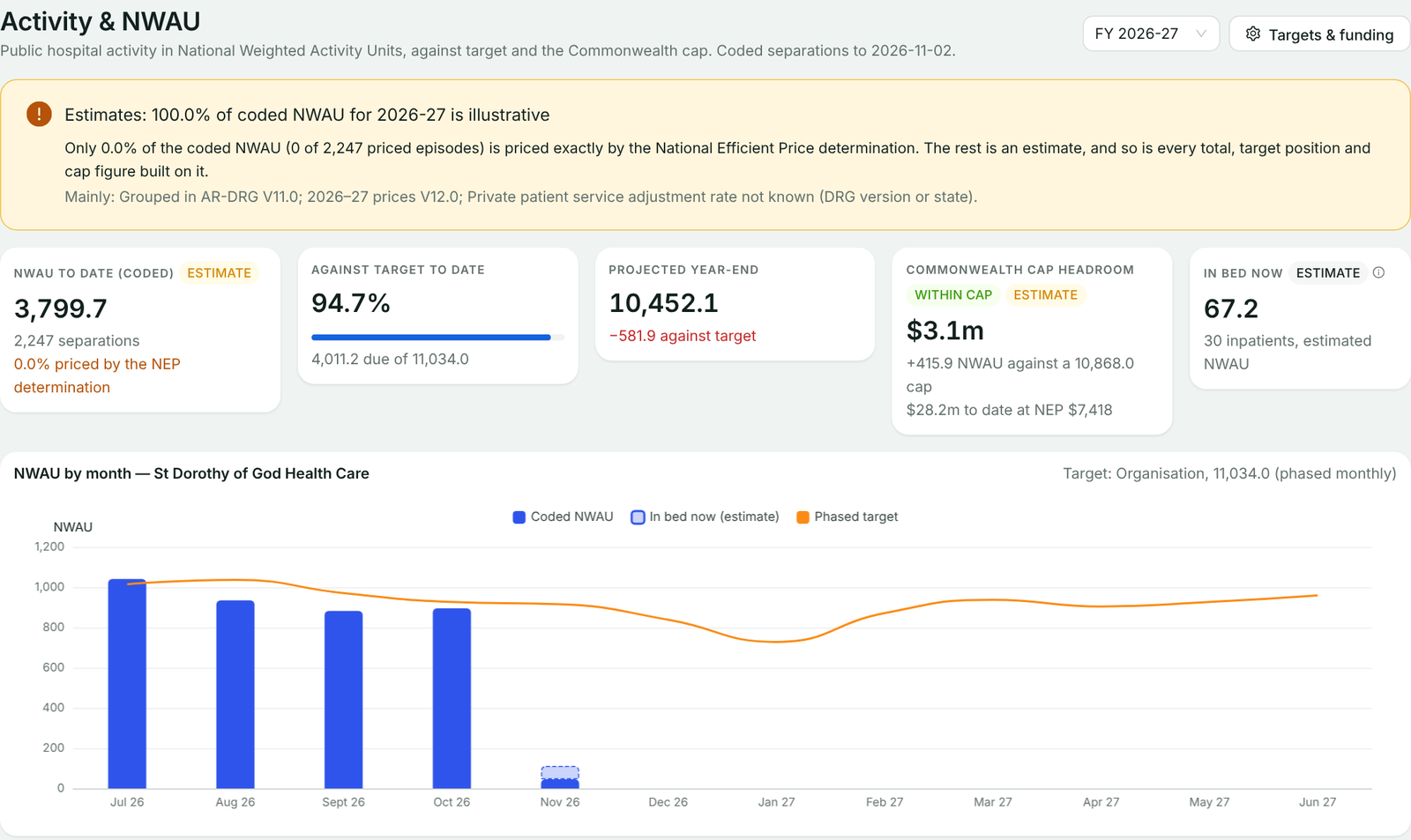
- Funding known before year end. Every coded episode is priced as the year runs, against a phased target and the Commonwealth cap.
Daily bed and place occupancy across every facility.
Admissions, discharges and length of stay, by facility, admission source and separation mode.
Falls, pressure injuries, medication errors and restraint events.
Revenue, cost allocation and margin by service line.
No pipeline project to wait for
Most healthcare data warehouse projects start by building pipelines out of every system, and the board waits months for its first report. HealthOS fills its data warehouse from the care already recorded, so you report from one record.
- In a warehouse projectPipelines are built out of every system firstOn one care recordThe warehouse fills from the care already recorded
- In a warehouse projectA model is designed before the first reportOn one care recordCurated views already answer the questions executives ask
- In a warehouse projectReports run on last month’s extractOn one care recordDashboards and your own reporting tool read today’s data
- In a warehouse projectThe workbook and the dashboard count things differentlyOn one care recordOne certified model, so every tool agrees on each number
- In a warehouse projectA new question joins the analysts’ queueOn one care recordAnyone asks in plain English and gets an answer
Answers on day one
Curated views already answer the questions executives ask, so you’re not waiting for a model to be built. For your analysts, that’s a star schema kept beside the operational record: dimension tables for facilities, wards, patient types, providers and funding accounts, with fact tables built for care sector reporting.
- Occupancy trend by facility, ward and room type
- Incident rates per 1,000 bed-days, with benchmarking
- Connect your own reporting tool through standard SQL database queries or a FHIR bulk export (the health record standard)
The facts are read through one certified model of measures and definitions, so your reporting tool, an export and the dashboards in HealthOS agree on what each number means.
No surprises at audit
Every intake, assessment, service order and clinical entry is captured as an event, and every change keeps the user, the time and the before and after values, for seven years.
- Standard CSV, JSON and FHIR R4 exports, without custom ETL
- De-identified cohorts for research
Everyone reads the same numbers
The board has its dashboard, finance its workbook and analysts their own reporting tool, and all three are counted the same way.
Your own tools, the same numbers
Excel and Power BI connect to the warehouse’s certified measures through a feed, each analyst with their own access token, so the workbook on the finance team’s desk and the dashboard in front of the board are counted the same way.
Figures no system carries, such as a budget or targets by home and month, can be uploaded from a spreadsheet and reported beside the record. They are marked as uploaded, so they are never taken for certified measures.
Ask a question, get an answer
Anyone can ask a question in plain English, such as “falls by facility this quarter”, and HealthOS finds the right pre-built metric and narrates the answer. Thresholds on any metric raise a notification when they are breached.
Funding seen coming
Know your funding before year end
Every coded episode is priced in National Weighted Activity Units by the National Efficient Price Determination, against a phased target and the Commonwealth cap, and a public hospital network’s own warehouse extracts can be imported and priced the same way.
Report across the systems you keep
Data from the systems around HealthOS lands in the same record, so one report can cover them all without a replacement project. Your IT team can bring it in as HL7 v2 hospital messages, FHIR bulk data, CSV spreadsheets, SFTP (secure file transfer) or staging tables from PostgreSQL, MySQL and SQL Server sources, including cloud data warehouses.
Before you ask
| Question | Answer |
|---|---|
| Does it replace our enterprise data warehouse? | It does not have to. HealthOS can feed the warehouse you run, through SQL, CSV, JSON or FHIR R4 bulk export, and read from it through staging tables. |
| What is not in the warehouse yet? | Claims facts are in build, and claims reconciliation views are on the roadmap. The Data & insights page keeps the current list. |
| Is it built on standards? | Yes. The record is aligned to FHIR R4 and conforms with the AU Core profiles, so the warehouse and the exports use standard resources. |
Related
See your own numbers in a healthcare data warehouse
We will walk you through it on real data. Bring the hardest thing your current system can’t do.