How it all fits together
Three portals on top, one FHIR record in the middle, and the Australian healthcare integrations you need already inside. It's the picture CIOs and clinical leads ask to see in the second meeting, laid out on one page with no black boxes.
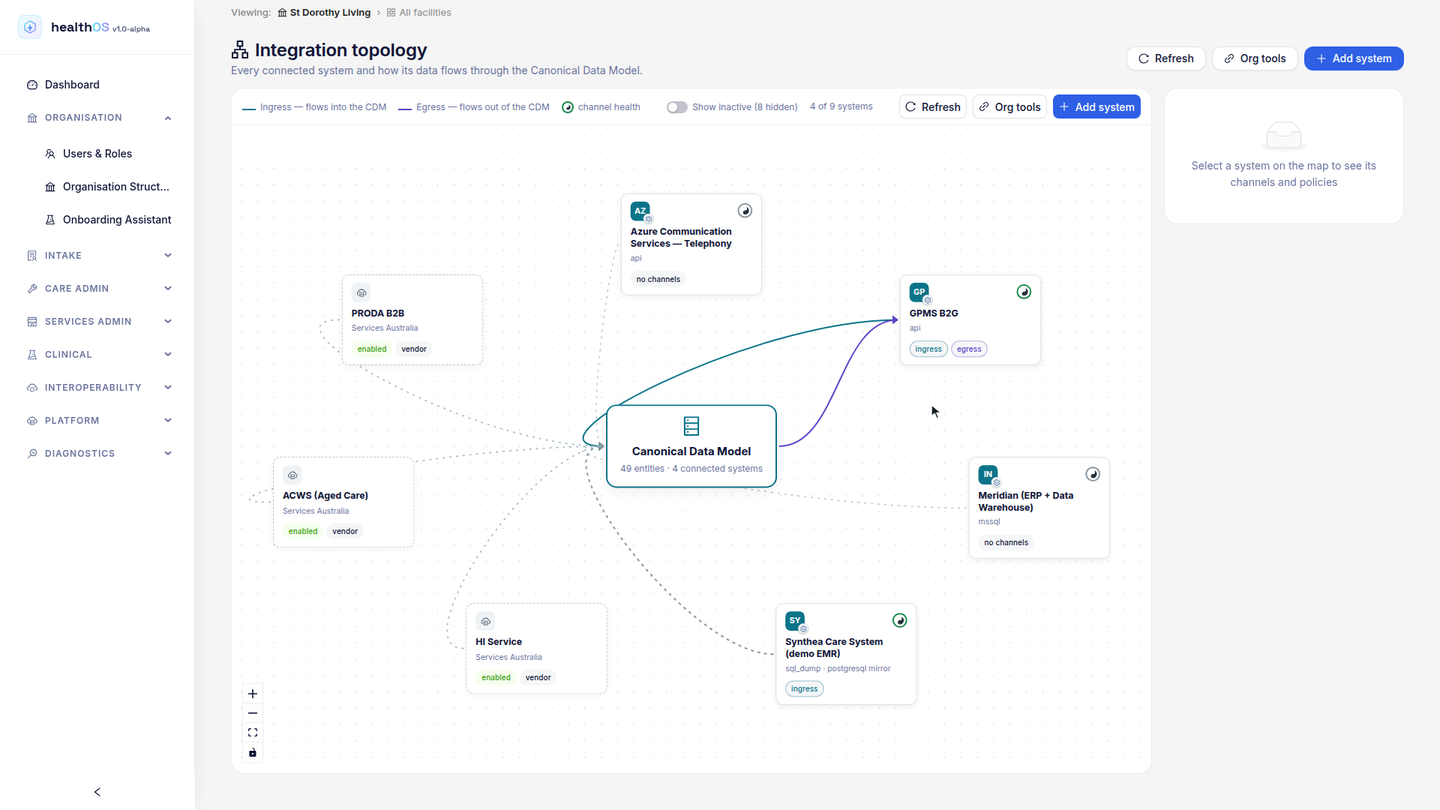
For clinicians, intake coordinators and case managers: triage, service ordering and dashboards. Web, single sign-on, branded for your organisation.
For patients, family members and advocates: schedules, messaging, invoices and consent. Web, mobile-friendly, signed in by magic link.
New. For field care workers: shifts, GPS check-in, visit notes and family messages. Mobile-first, offline-tolerant, with GPS and NFC.
From the portals down to the government rails
A secure API gateway
Every call from the portals passes through one gateway. It runs as container apps in your own cloud tenancy, and traffic is governed by your existing identity provider and reverse proxy, with your MFA.
- FHIR R4 / AU Core, over REST and GraphQL
- Role-based access
- Audit on every call
One person, one record
The Canonical Care Record holds one record per person, onshore in your tenancy. Every event, observation and order is projected as AU Core FHIR resources on read, through an AU Core FHIR R4 API: Patient, Encounter, ServiceRequest, Observation, CarePlan, Goal, Condition, MedicationStatement and Account.
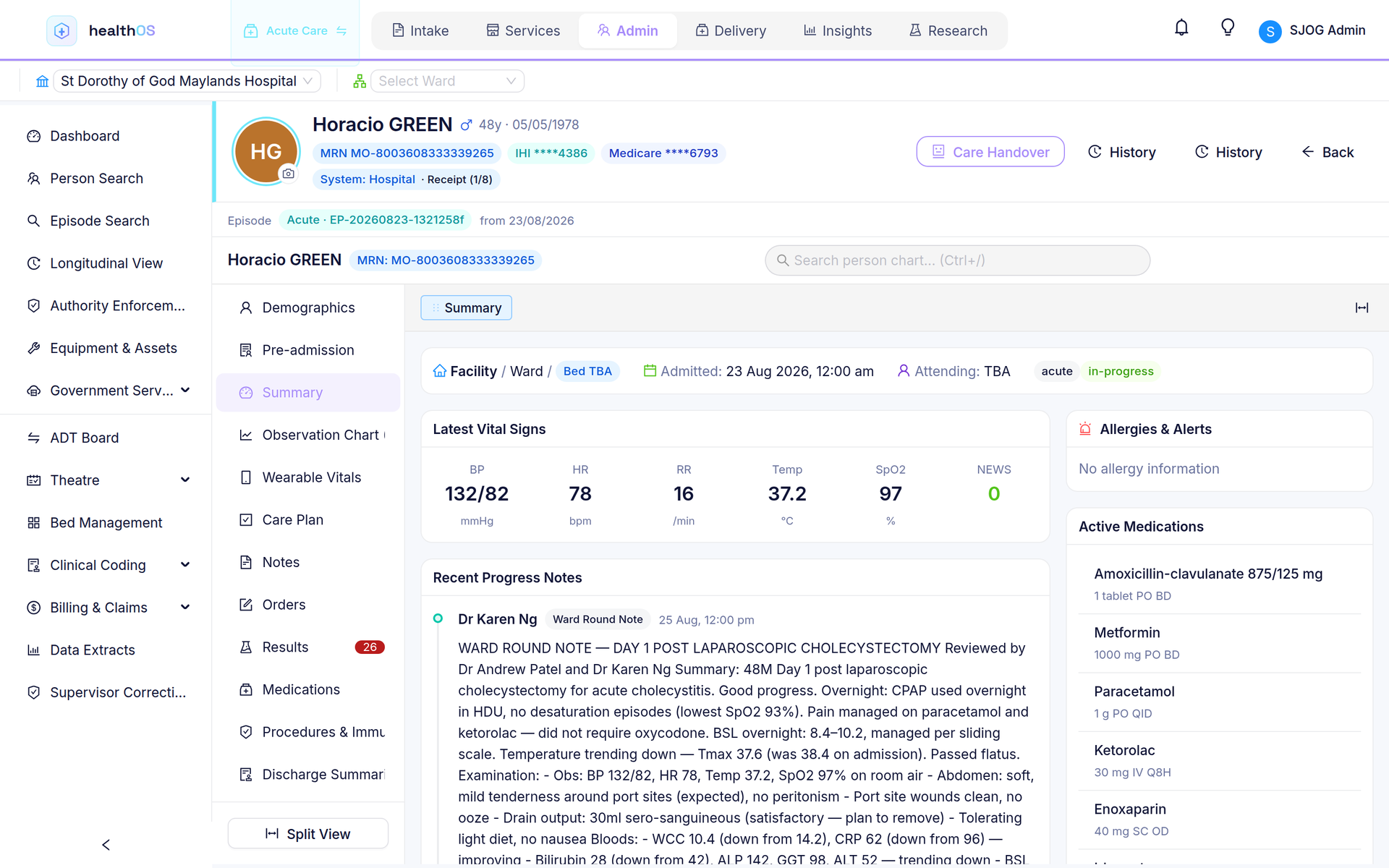
Engines that work on the record
Three engines sit on the record: deterioration detection, the pathways engine and the rules engine.
Event-driven and bi-directional
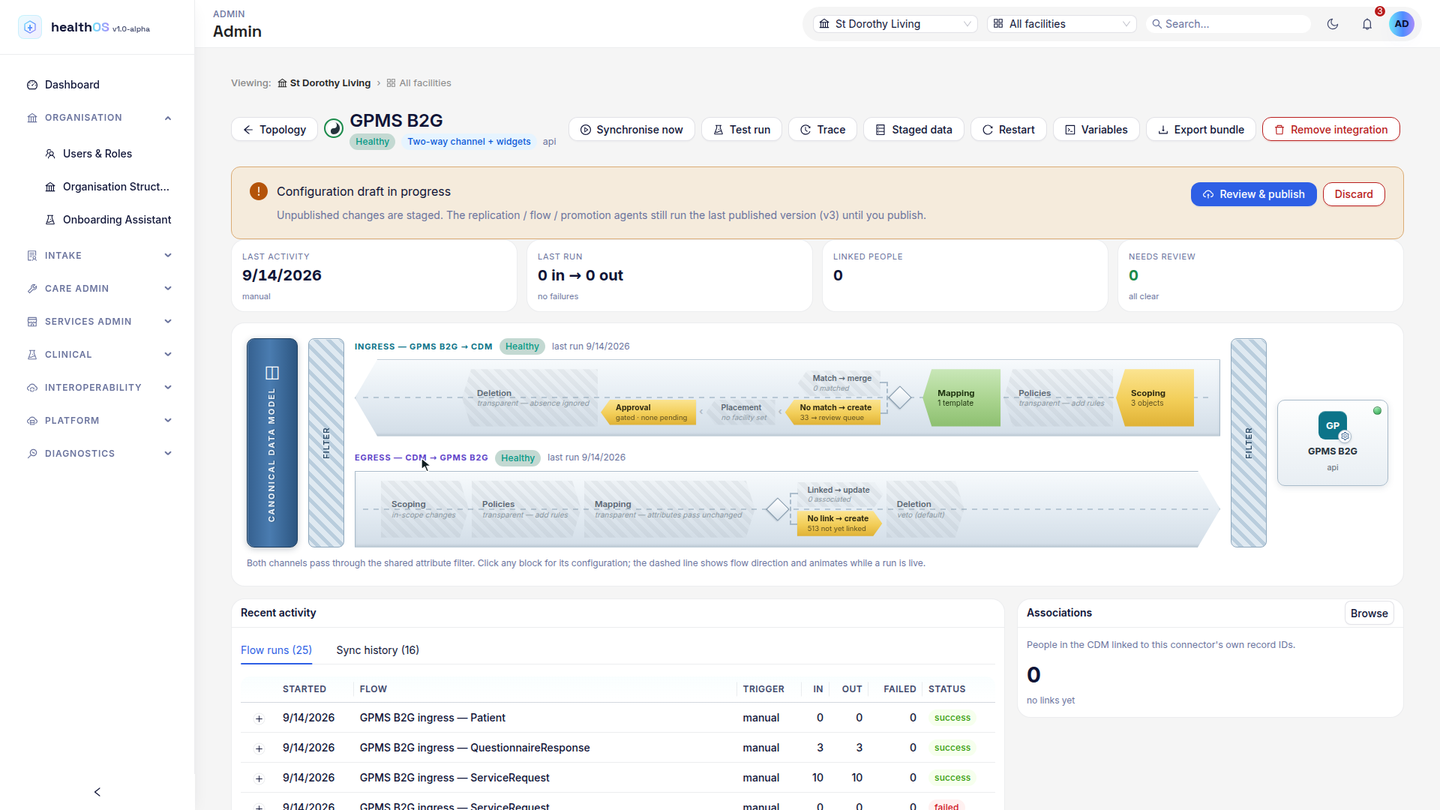
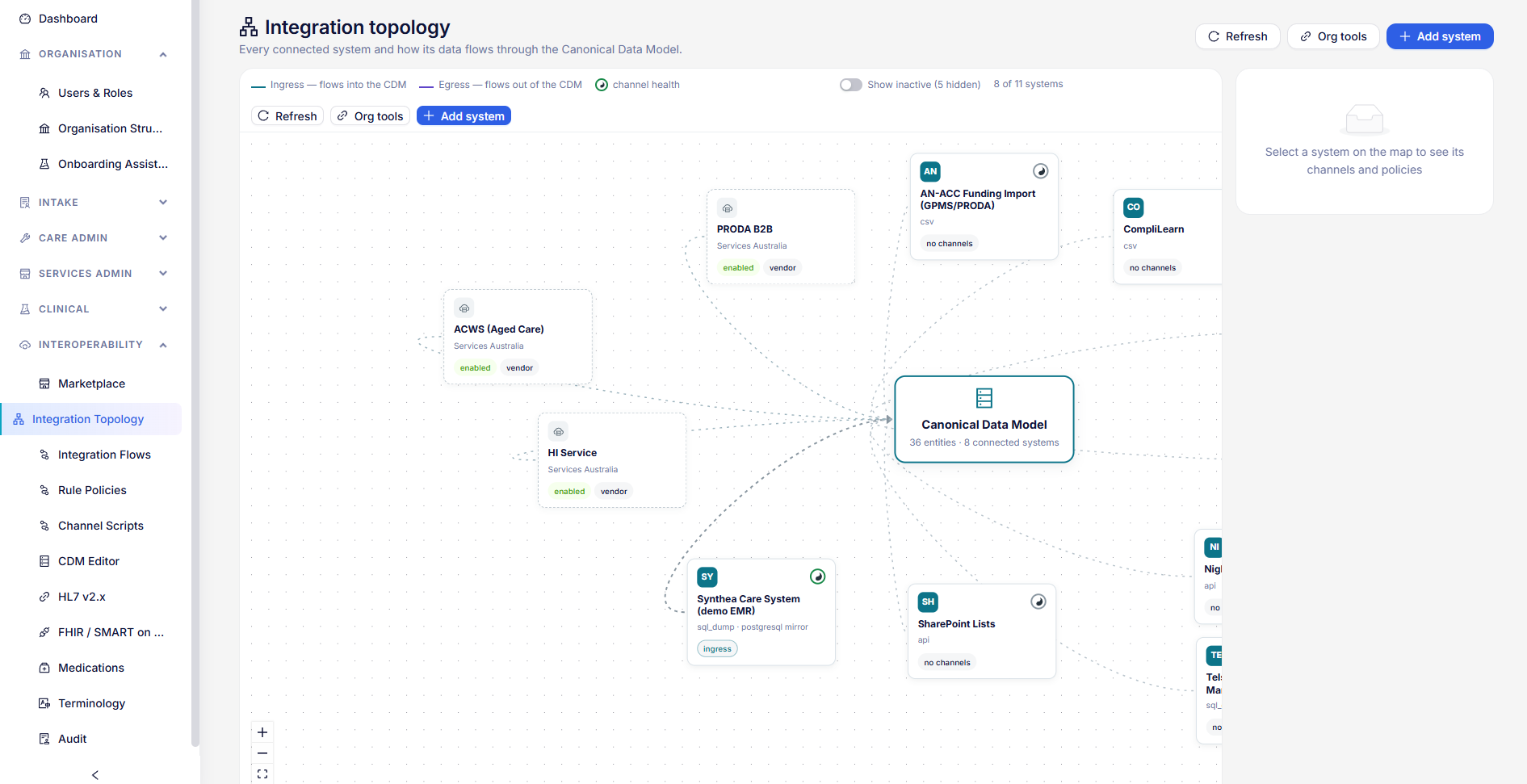
The integration hub moves data in near real time, in both directions, between the record and the systems around it. It also supports SMART on FHIR.
Every Australian healthcare integration, already inside
The government rails connect straight to the record. See Government services for where each one stands.
| Rail | What it does |
|---|---|
| Medicare + HI Service | National health identifier (IHI) verification, and Medicare and DVA validation. |
| Services Australia | PRODA secure provider login, Aged Care Web Services claiming (ACWS), the GPMS provider reporting gateway and Medicare claiming. |
| My Health Record | Access to shared health summaries and discharge documents through the national My Health Record. On the roadmap: the integration application is submitted and in progress. |
The systems you already run
HealthOS connects to the systems you keep, in both directions where it matters.
| System | How it connects |
|---|---|
| Patient administration (PAS) | Admissions, transfers, discharges and bed management from your existing PAS. |
| ERP and finance | Service orders post automatically to your ERP for invoicing and claiming. |
| Electronic health record (EHR) | Clinical records, discharge summaries and medications from your existing EHR. |
| Email and calendar | Your email platform's API, for referral email parsing, calendar and notifications. |
| AI and LLM | De-identified handover to your cloud LLM. It runs in your tenancy, and no data leaves your environment. |
| Data exports | Standard CSV, JSON and FHIR R4 exports for your reporting tools. |
| Bulk data import | CSV, SQL dump, SFTP and the standard health-data formats (HL7, FHIR Bulk), with automated person matching and field mapping. |
| SMART on FHIR | A full OAuth2 authorisation server. Third-party healthcare apps register, authenticate and reach clinical data through the standard SMART launch, with .well-known discovery and OAuth2 client registration. |
Devices that report without a phone
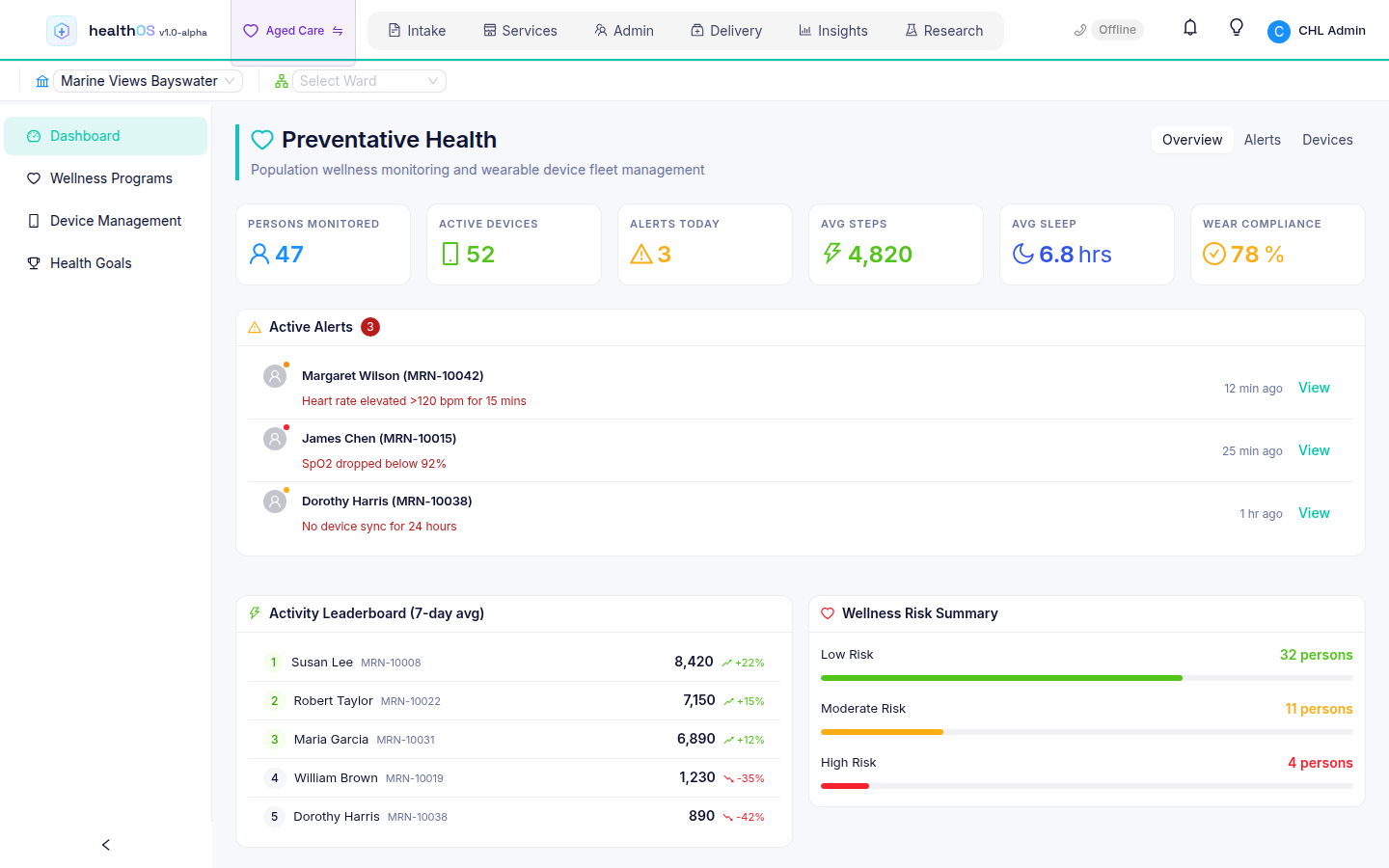
When care moves home, monitoring follows. Cellular blood pressure monitors, watches and smart scales connect through the device maker's OAuth webhook API, with no smartphone required. Continuous glucose readings are new, and arrive through the glucose monitor maker's cloud API.
What each module reads and writes
Each module draws on a different set of systems. This is where the data flows for each one.
| Module | Reads from | Writes to | Reads and writes |
|---|---|---|---|
| Intake | PAS, Email and calendar | ERP / finance | Staff portal, Services Australia, Medicare + HI Service |
| Services | - | HealthOS Connections, HealthOS Worker, ERP / finance | Staff portal, Services Australia |
| Insights | - | Staff portal, Data exports | - |
| Integration | Bulk data import | AI / LLM | PAS, ERP / finance, EHR, Services Australia, My Health Record, Medicare + HI Service, Email and calendar, SMART on FHIR |
| Delivery handover | EHR | Staff portal | AI / LLM |
| Monitoring | Home monitoring devices, Continuous glucose monitors | Staff portal, HealthOS Connections | - |
| Research | EHR | Data exports, AI / LLM, SMART on FHIR | - |
See it in action
 6:31
6:31The short version
 2m 52sHow It Fits TogetherThe technical architecture: ingress, the governed record, egress, tenancy and the government rails.
 1m 09sESB OverviewConnect everything. Rip out nothing.
 1m 04sData ReplicationYour database, mirrored into the record.
 2m 16sSecurity & SovereigntySecurity that does not require trust.
Related
Want to talk it through?
Tell us what systems you run and where the friction is, and we'll come back with how HealthOS would fit, with no obligation.