Turn care already given into research funding Say yes to research partners without a data project.
Research is the part of the care record your researchers use: it takes the care your clinicians already coded, and hands partners a de-identified dataset.
- No separate data warehouse. The record that drives service orders and progress notes is the record you query.
- No clean-up before a study. Data is coded to Australian standards as care is given, so nothing is cleaned up afterwards.
- Ready for the ethics committee. Every export has its identifiers removed and carries a de-identification audit trail.
Inpatient cohorts by diagnosis code and admission date, with referral pathway and discharge analysis.
Community care intervention research.
Quality Indicator data and resident outcome studies.
The National Disability Insurance Scheme outcome measurement studies.
Research from care already recorded
The record you already keep becomes research-ready, without a new data project every time, so you can say yes to the partnerships and grants that help pay for care.
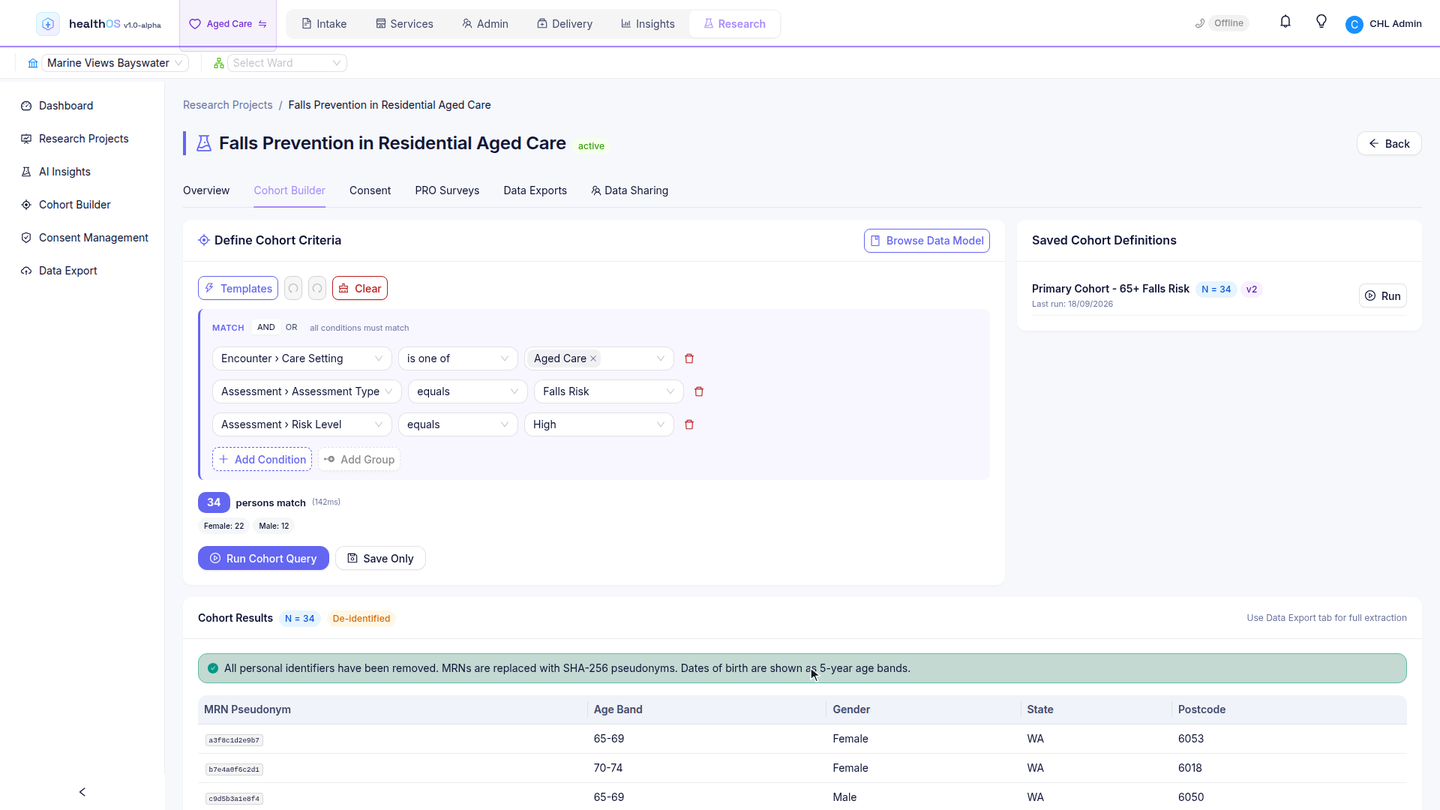
Query the record you already keep
Most research platforms need a separate data warehouse, a separate data loading pipeline and a separate coding exercise. HealthOS captures structured, coded clinical data during normal care delivery. The record that drives service orders and progress notes is the record you query for research.
- Query by diagnosis code
- Filter by admission date and type of encounter, from a hospital stay to a home visit
- Filter by assessment scores and clinical observations
- Segment by service type, funding stream or location
- Combine criteria across the full clinical record
No clean-up before a study
Every clinical entry is captured as structured data against Australian terminology standards at the point of care. Nothing has to be cleaned up for research after the fact.
The Common Data Model browser lets you query the underlying canonical data model directly, so you can understand the shape of the data, inspect value distributions and check coding completeness before you build a cohort.
Researchers and clinicians on one platform
From a question to a dataset
Clinicians and researchers in the same organisation can move from a clinical question to a structured dataset without waiting for a data team to build a pipeline.
Cohorts export in the national health data standard, or as a spreadsheet or data file, which slot straight into research tools and statistical packages.
- Health data standard, spreadsheet and data file exports
- Cohort definitions saved and reproducible
- Ethics-ready extracts with a de-identification audit trail
- Seven years of longitudinal data from the audit trail
Trials without a separate trial system
You can run interventional studies without standing up a separate EDC or CTMS.
The research module goes beyond cohort extraction. It supports the full study lifecycle, from protocol design through participant enrolment, randomisation, scheduled assessments and compliant data export, on the same platform clinicians use every day.
- Randomised allocation with configurable arms and ratios, with every allocation recorded
- Protocol-defined visit schedules with windows and tolerances
- Progress tracked against the protocol timeline, with overdue assessments flagged
- Informed consent tracked by study, version and participant, including withdrawal, re-consent for protocol amendments and a complete consent audit trail
De-identified before it is used
Datasets an ethics committee can approve
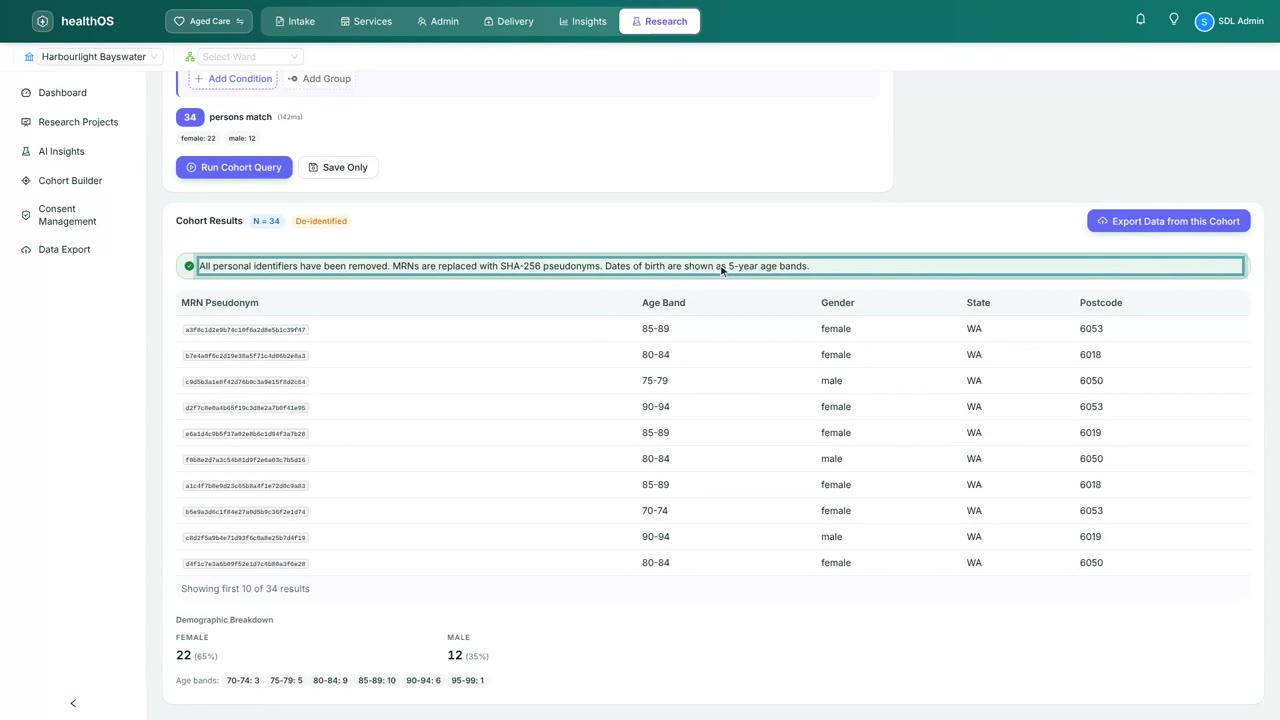
Export research-ready datasets with identifiers removed. The engine removes direct identifiers such as names, Medicare numbers and addresses, hashes the medical record number and generalises dates of birth to age bands. Each dataset belongs to a project that records its ethics approval.
- Direct-identifier removal
- Medical record number hashing
- Dates of birth generalised to age bands
- Ethics approval recorded on the project
AI that can stay in your own cloud
Generate clinical handover summaries, discharge letters and research insights with a large language model. Handovers and discharge summaries have names and identifiers taken out before the model reads them, and you can require every AI call to stay in your own Azure tenant.
- Identifiers taken out of handovers and discharge summaries
- Every AI call in your own Azure tenant, when you require it
- Clinical handover, discharge summaries and shift reports
- A full audit trail of every AI interaction
See it in action
 2:04
Related
See which studies your own record could support
We'll walk you through it on real data. Bring your questions.