Two decades in Australian care, and why we built this
HealthOS grew out of two decades inside Australian hospitals, aged care and home care, building and running the systems care depends on. We kept seeing the same person recorded three times, in three systems that were never built to talk.
One person, not three
For more than twenty years I have worked on the technology behind Australian care. For much of that time I was responsible for architecture and integration at a national provider that ran hospitals, aged care homes and home care services side by side. Every one of those services ran good systems. None of them could see the whole person.
The same person could exist in our organisation three times: once as a hospital patient, once as an aged care resident and once as a home care client, each with their own record and their own history. When an existing home care client was admitted to one of our hospitals, or signed up for another of our services, they were registered as a brand new person. Their allergies, their medicines and their story started again from nothing.
The hospital team couldn't see what the home care team already knew. A patient was discharged, and the summary went out by fax to a service in the same organisation. The office typed the same details into a government portal, a billing system and a spreadsheet, and month-end claims were rebuilt by hand.
None of that is a shortage of information. The hours are already paid for, the proof is in the care already given, and the insights are in the data already recorded. It is all just trapped between disconnected systems, at a time when the sector is being asked to do more with fewer workers than it needs.
So we built HealthOS to connect what providers already run, add what is missing, and hand it back: workers who can see the whole person, families who can see what is happening, and providers who can sustain it. We would rather show you than tell you, which is why every claim on this site comes with a film of the real product.
Aaron Le Saux
Founder and CEO
Keep what you run. We make it talk.
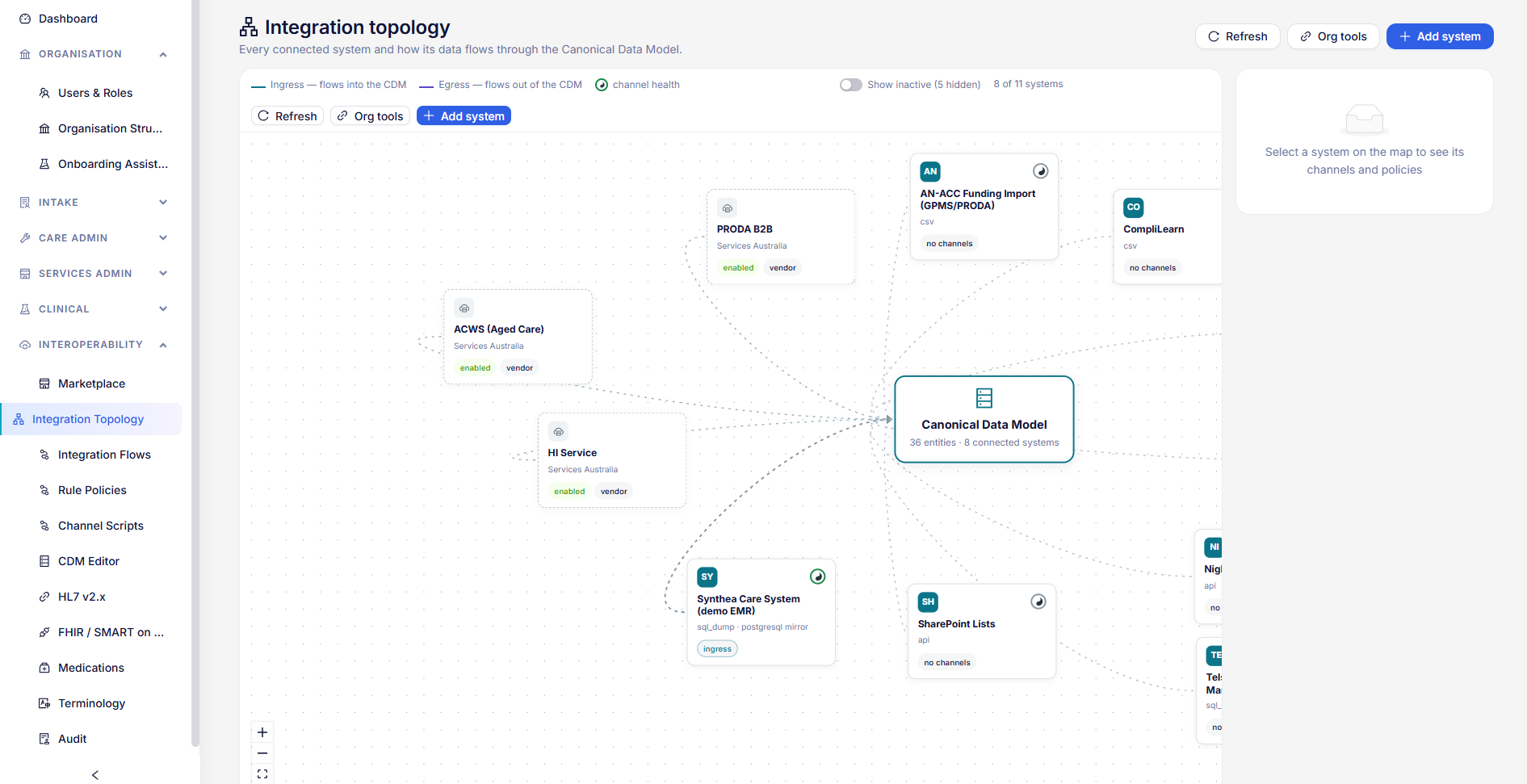
Australian care doesn't need another system to replace the ones that work. It needs the layer that joins them, and the modules none of them do well.
Things are written once, and the clinician sees the whole person in one place: their past, their present and their planned care.
Nothing about a person is lost between systems, and families can see what is happening without chasing.
Admin hours come back, the organisation runs on the live record, and that record becomes research-ready.
Checkable milestones, not promises
Connecting to government systems in Australia means passing their conformance testing first. This is where each integration stands.
| Integration | Status |
|---|---|
| Healthcare Identifiers (HI) Service | Conformance passed |
| Aged Care Web Services (ACWS), Services Australia | Testing passed, including Support at Home budgets, entry and departure, claiming and reconciliation |
| GPMS business-to-government, Department of Health | Conformance testing passed |
| Eclipse (Medicare, DVA and health fund claiming) | In Notice of Integration testing with Services Australia |
| Electronic prescribing | Built; not yet conformance assessed by the Australian Digital Health Agency |
Aaron Le Saux
Founder and CEO
More than 20 years leading healthcare technology in Australia.
- National Manager ICT Architecture at Calvary Health Care, a national provider of hospital, aged care and home care services
- Architect of the MyHomeHospital virtual-hospital joint venture
- A decade at St John of God, delivering technology for capital projects
- Delivered the real-time location system at the new Footscray Hospital
See it for yourself
Every film on this site is a screen recording of the real product. Pick your care setting, or talk to us about yours.