Clear the coding backlog Episodes coded and ready to claim sooner.
Code Captain is an AI autocoder that reads an episode’s documents and codes them the way a coder does.
- Coders review a draft. Your coders accept, change or reject each code instead of starting from a blank page.
- Every code traced. Each one shows the document, the sentence and the classification path behind it, and the final report PDF keeps it for your own records.
- No patient details reach the AI. Scanned pages are read with text recognition and the patient’s identifying details removed in your browser; only the de-identified text you approve is sent to the AI model.
- Code Navigator included. Every code opens in the coding screen, and the episode groups on a grouper certified for AR-DRG V12.0 and V11.0.
Tech preview, free until 1 January 2027. Code Captain is still being finished, so nothing is charged while HealthOS online is in tech preview. Sign up without a card. We may end the preview earlier, and you will hear from us before anything is charged.
 4:00
Every code traced to the record
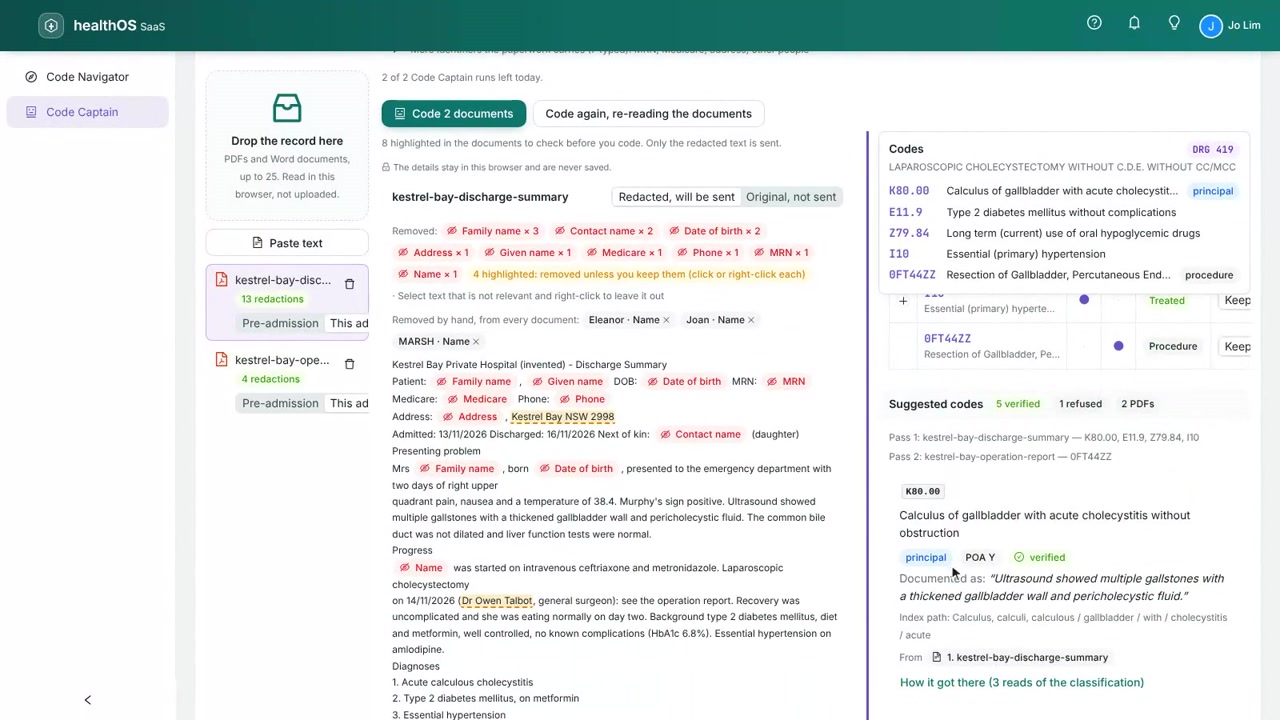
Code Captain codes from the episode’s own documents, and quotes the line in the record behind every code it proposes.
Coded the way a coder codes
Give Code Captain an episode’s documents and it works through them the way the classification is meant to be used. For each condition or procedure it searches the index and follows every cross-reference, then verifies the candidate in the tabular list. A code it cannot trace through the index and the tables is dropped. It is not taken from the model’s memory.
It codes the full picture: a neoplasm’s morphology alongside its site, and the external cause of a poisoning or injury. It follows the coding standards for the episode, and flags a diagnosis that is on the hospital-acquired-complications list for you to confirm. Each code it proposes shows the document, the sentence and the path through the classification behind it.
- Each code traced to its document, sentence and classification path
- The full picture coded: a neoplasm's morphology, a poisoning's external cause, the standards for the episode
- Hospital-acquired complications flagged for you to confirm
- Codes it cannot trace are dropped, not guessed
Your coders stay in charge
Code Captain writes the draft. Your coders make every decision, and their coding is the measure it is fitted to.
Every code is the coder’s call
Code Captain’s output is a draft: you accept, change or reject each code, and the grouper re-runs on what you accepted. Clinical interpretation, documentation queries to the clinician and the final code set stay with the coder. Each run stays in your workspace until the nightly purge, and its final report is yours to export. A hospital that wants coding worklists and a coding timeline, with every assignment attributed, gets them on the full platform’s clinical coding.
- You accept, change or reject every code
- Each run kept until the nightly purge: the documents read and the codes proposed
No training set to hand over
Code Captain is not trained at all: it reads the classification itself, the way a coder does. Many autocoders have to be trained on hundreds or thousands of coded documents before they are any use. To fit it to your casemix, what Code Captain needs from you is a spread of records your coders have already coded, across each specialty.
Each record is run through Code Captain end to end in an automated browser, and every step it takes is captured: the index searches, the tabular entries it opened and the codes it proposed. An AI agent compares the result with your coders’ codes and finds where Code Captain went wrong. It fixes how Code Captain reads, searches and checks, never the answer for that record. Then the records are run again. Round after round, the misses in each specialty are worked out.
Others are built on hundreds of hand-written retrieval rules, which still miss. Code Captain’s loop finds the fault in the method and fixes it once, for every specialty.
- No model is trained, so there is no training set to hand over
- A spread of coded records in each specialty is enough to start
- Records are de-identified before they are used
- Every fix is to the method, never a code written in for one record
- Your coders’ codes stay the measure
Codes you can defend
Accepted codes group in Code Navigator, on a grouper certified for AR-DRG V12.0 and V11.0. Code Captain itself never sees what an episode is worth.
The AI never sees the diagnosis related group
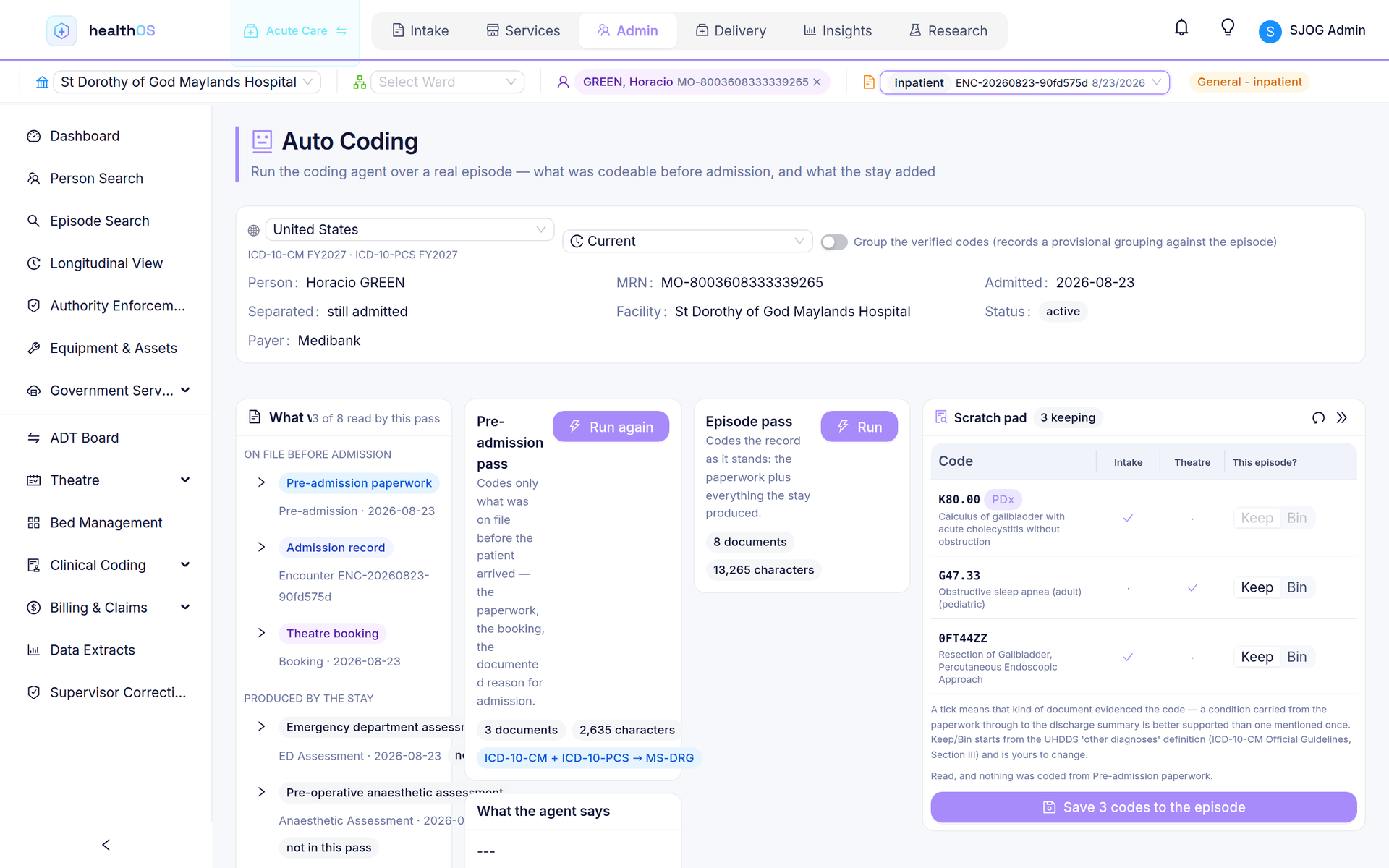
Code Captain comes with Code Navigator, the coding screen it works in. The codes it proposes go into the Code Navigator’s worksheet, where you open each one in the index and tabular list, see what it still asks for and watch the live diagnosis related group and the episode’s weighted activity update before you accept it.
No diagnosis related group, cost weight or weighted activity reaches Code Captain: not in what it reads, not in its tools and not in its instructions. It codes what the record documents, following the classification and the coding standards. The diagnosis related group and the episode’s weighted activity appear afterwards, in the Code Navigator, for the episode as a whole and never beside an individual code.
- The Code Navigator, the live diagnosis related group and the episode’s weighted activity included
- Code Captain never sees the diagnosis related group or weighted activity, so it cannot code towards one
Text recognition and de-identification in your browser
When you upload a discharge summary or an operation report, your browser reads the PDF itself, using text recognition for scanned pages, and removes the patient's identifying details before you see a preview. Only the redacted text you approve is sent. The server checks it again and refuses it if an identifier has survived. Your coding is stored in Australia, in a tenancy that the database itself keeps apart from every other subscriber's.
- Scanned pages read with text recognition in your browser, not uploaded
- The patient’s identifying details removed in your browser, before you see a preview
- Only the de-identified text you approve reaches the AI model
- A second check on the server, which refuses text with an identifier in it
- Data stored in Australia
- Each subscriber isolated by row-level security in the database
$249 per coder a month, Code Navigator included
Code Navigator + Code Captain is $249 per coder a month, with 200 Code Captain runs per coder each month, shared across your team, and is free while HealthOS online is in tech preview. See pricing.
- 200 Code Captain runs per coder each month, shared across your team: 5 coders get 1,000 runs between them
- Prices in Australian dollars, excluding GST
Which books, and where your data goes
| Question | Answer |
|---|---|
| Which classifications are included? | Australian diagnosis and procedure codes with Australian Refined Diagnosis Related Groups grouping for Australian coding, and United States diagnosis codes, United States procedure codes and Medicare Severity Diagnosis Related Groups for coding in the United States books. The grouper is certified for AR-DRG V12.0 and V11.0 (Code Navigator 1.0, Docker/Linux). |
| Where does my data go? | The Code Navigator records nothing you code. Code Captain’s runs and the redacted documents are kept in Microsoft Azure in Australia until your workspace’s nightly purge, after the period you choose (1 day, 7 days or 30 days). When you use Code Captain, the only thing sent to the AI model is the de-identified text you reviewed and approved in your browser, after a second check on our server. During the tech preview the model runs on Microsoft Azure's global deployment, so processing can happen outside Australia. Microsoft does not use it to train models; under its Azure OpenAI terms it may keep it for a limited time to monitor for abuse. We are testing an Australia-only deployment for organisations that need processing to stay onshore. |
Watch it code an episode
4:00Try it on your own backlog
Free while HealthOS online is in tech preview. Tell us what you code and in which books.